A Guna Yala Sailing Trip: What to Expect on a Catamaran Adventure in Panama
Affiliate Disclosure: This Guna Yala / San Blas Islands Catamaran guide contains affiliate links. If you click a link and make a purchase, I may receive a small commission at no cost to you. By visiting and using this website, you’re indicating your agreement to comply with our terms of service.
HI, I’M TARA!
I love sharing hidden gems far from the crowds, beautiful boutique hotels, unique road trip itineraries and unforgettable wildlife adventures – helping you have extraordinary travel experiences.
Introduction
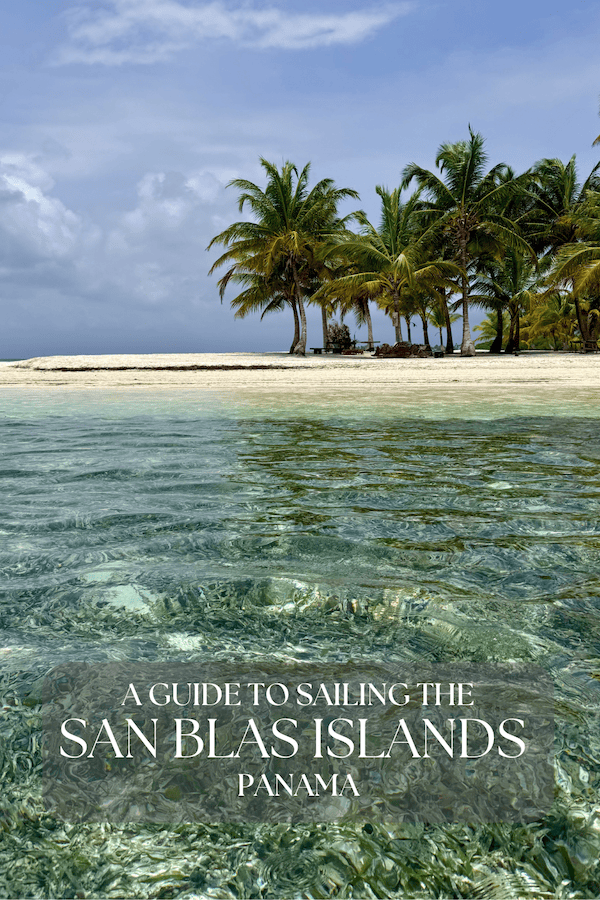
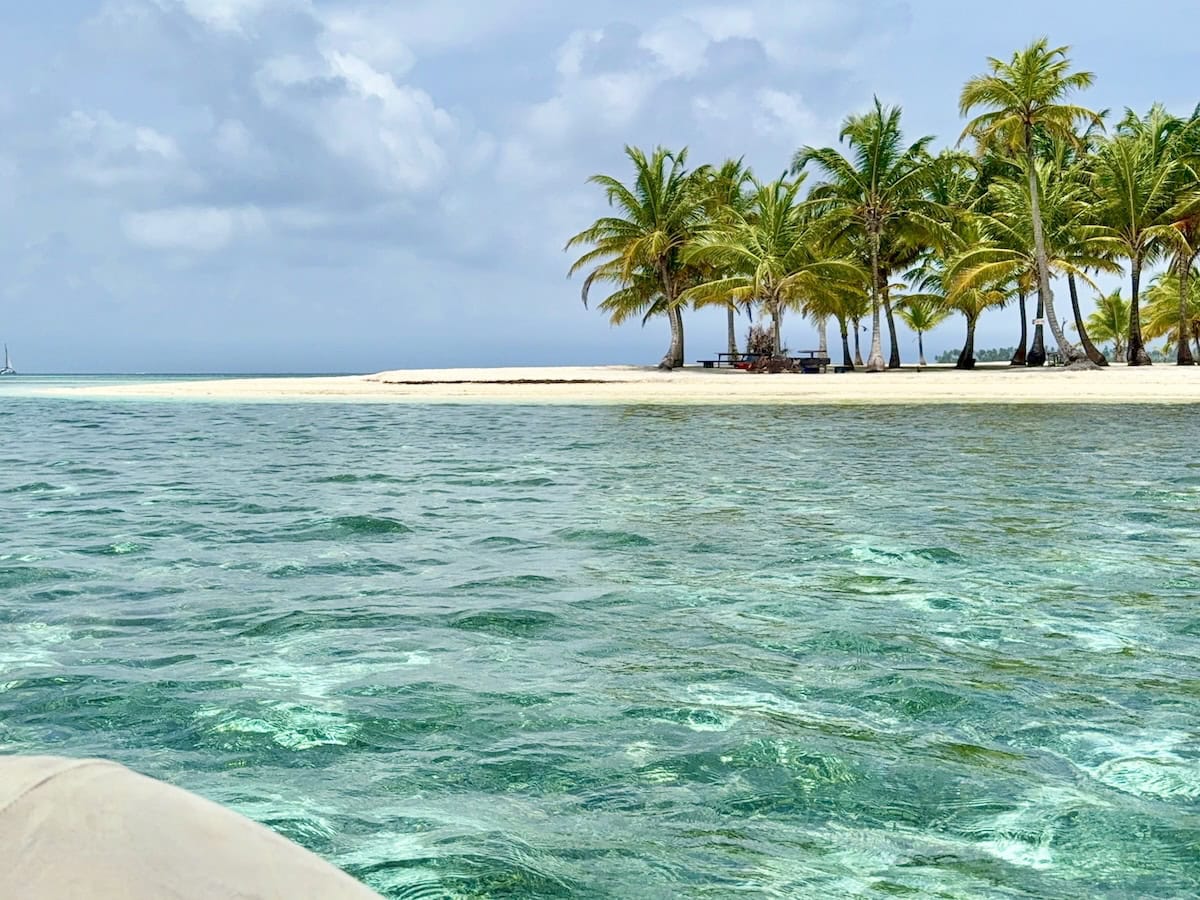
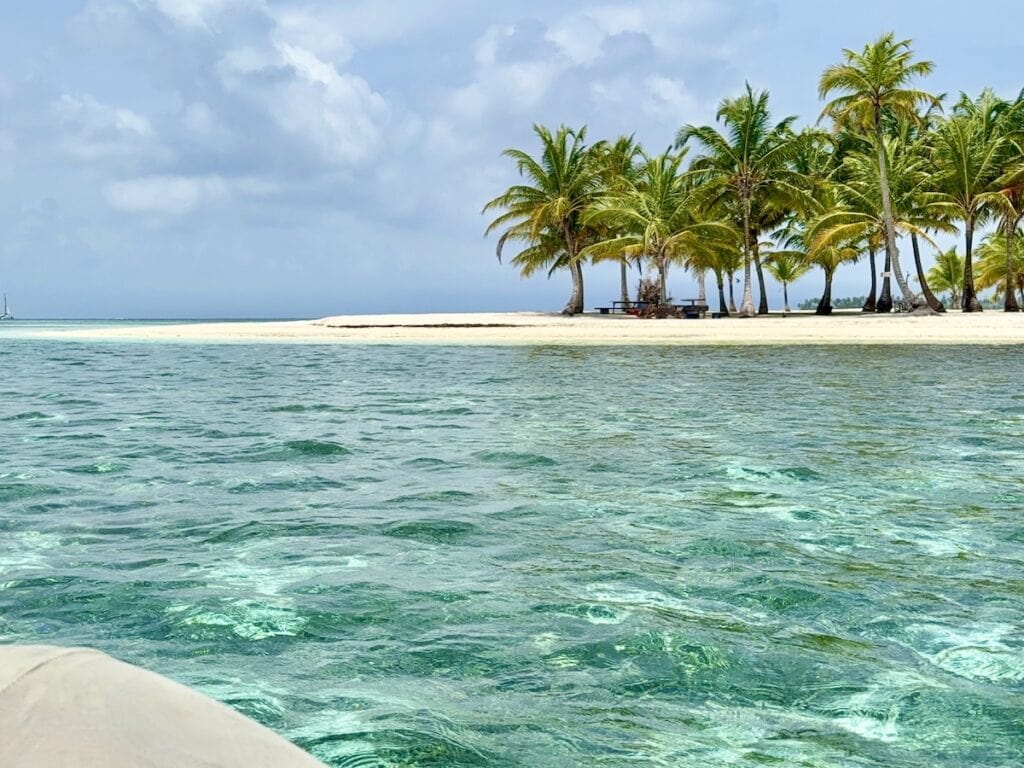
Guna Yala, also known as the San Blas Islands of Panama, is an autonomous Indigenous territory on Panama’s Caribbean coast. With more than 360 islands scattered across crystal-clear waters, it is one of the most beautiful places in the country to explore by sailboat.
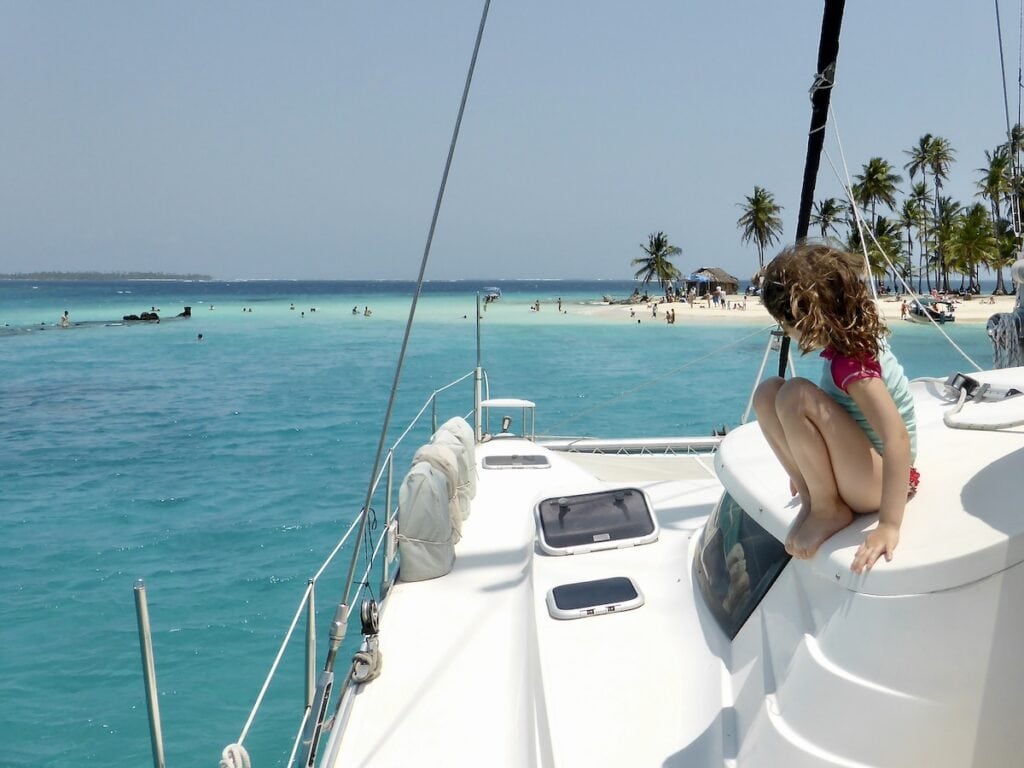
After visiting Guna Yala with my husband and two young children back in 2014, I finally had the opportunity to return—this time with my now 19-year-old daughter. We were fortunate enough to enjoy a four-day catamaran adventure through the archipelago with Ulu – I Travel By Boat, a San Blas Islands sailing charter company.
Thankfully, this magical place was every bit as special as I remembered. In fact, the trip exceeded my already high expectations. And for Ella, it felt almost like a brand-new destination. She was only six years old during our first visit and remembered little more than a few snippets of the experience.
Not only did we spend our days sailing through calm turquoise waters, snorkeling, paddleboarding, and exploring tiny palm-fringed islands on foot, but we also had the opportunity to learn more about the traditions and way of life of the Guna people. It was exactly the kind of meaningful, culturally immersive travel experience I had hoped it would be.
A note about the name: Throughout this article, you’ll see me use both Guna Yala and San Blas Islands. While Guna Yala is the region’s official name, and has been since 2010, San Blas Islands remains the term most travelers recognize and search for online. My hope is that by using both names, more people will discover this remarkable part of Panama while also becoming familiar with the name Guna Yala.
What Does a San Blas Islands Catamaran Trip Look Like?
Short on time? Here’s a 90-second glimpse of what it’s like to sail through Guna Yala’s turquoise waters, palm-fringed islands, and vibrant Indigenous communities.
About Guna Yala
While most visitors come to Guna Yala for its picture-perfect Caribbean islands, the region also includes a stretch of mainland coastline along Panama’s Caribbean shore. Located about a three-hour 4×4 drive (or much shorter chartered plan ride) from Panama City (followed by a boat ride into the islands), it is one of the most culturally unique destinations in the country.
While the palm-dotted islands and crystal-clear waters are certainly part of the appeal, it is the cultural experience that truly sets Guna Yala apart. The region has been an autonomous Indigenous territory for more than 100 years, allowing the Guna people—one of Panama’s seven recognized Indigenous groups—to preserve many of their traditions and way of life while welcoming visitors to their homeland.
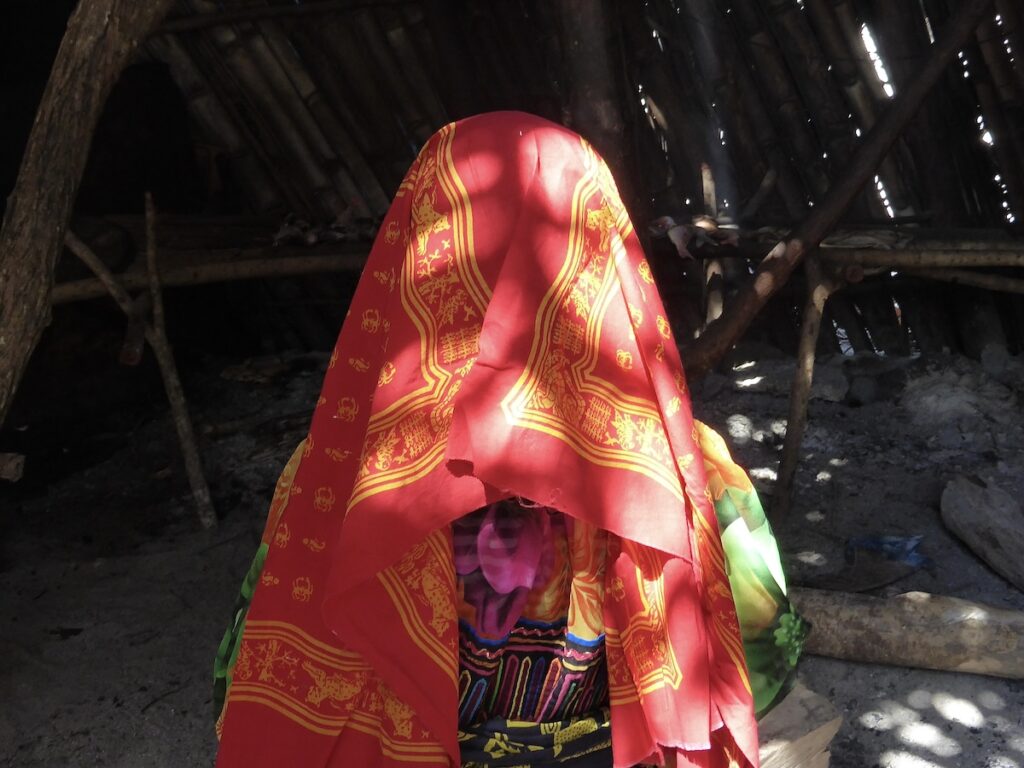
Today, many Guna families continue to rely on small-scale fishing and coconut farming, while tourism has become an increasingly important part of the local economy. Visiting the San Blas Islands offers a rare opportunity to experience a culture that remains deeply connected to its traditions while sharing them with respectful travelers.
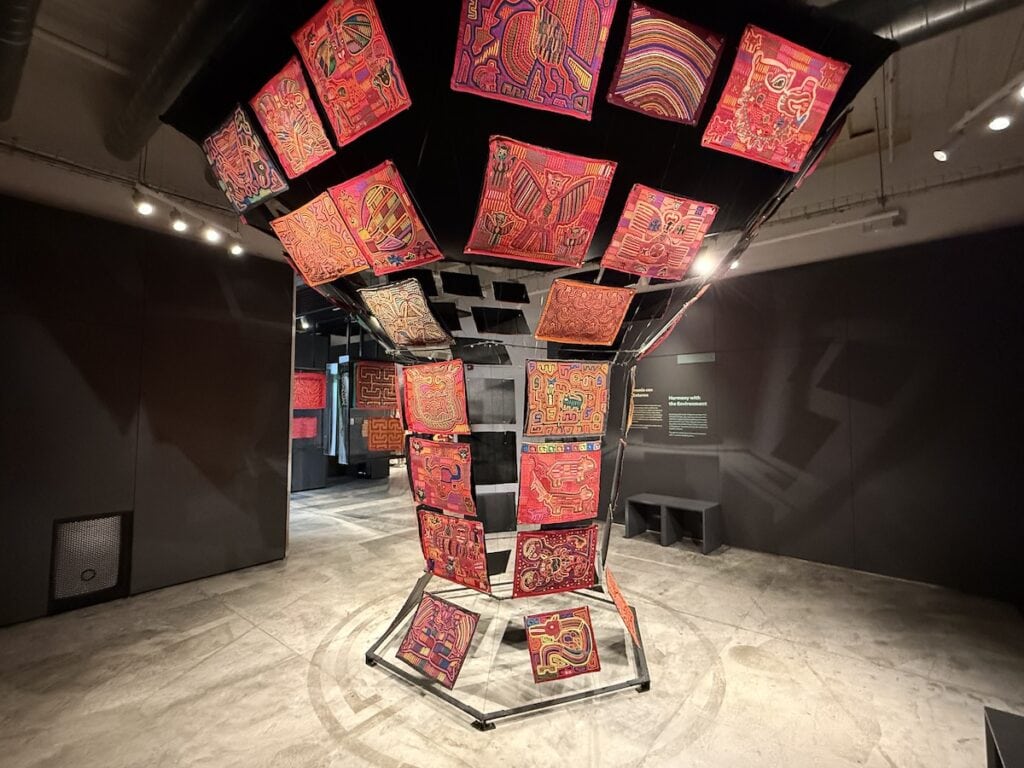
The Guna are perhaps best known for their colourful molas. These textile panels are created using a reverse appliqué technique in which layers of fabric are carefully cut and sewn to reveal elaborate patterns beneath. Originally part of traditional Guna women’s clothing, molas have become one of Panama’s most recognizable forms of Indigenous art and make meaningful souvenirs that directly support local artisans.
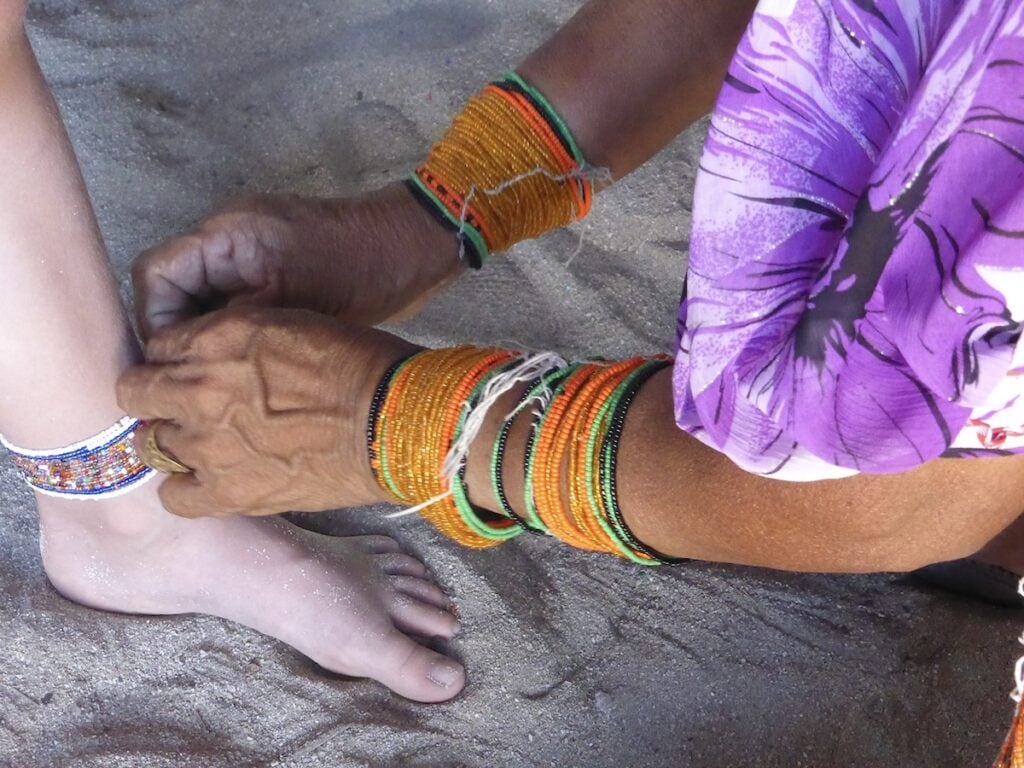
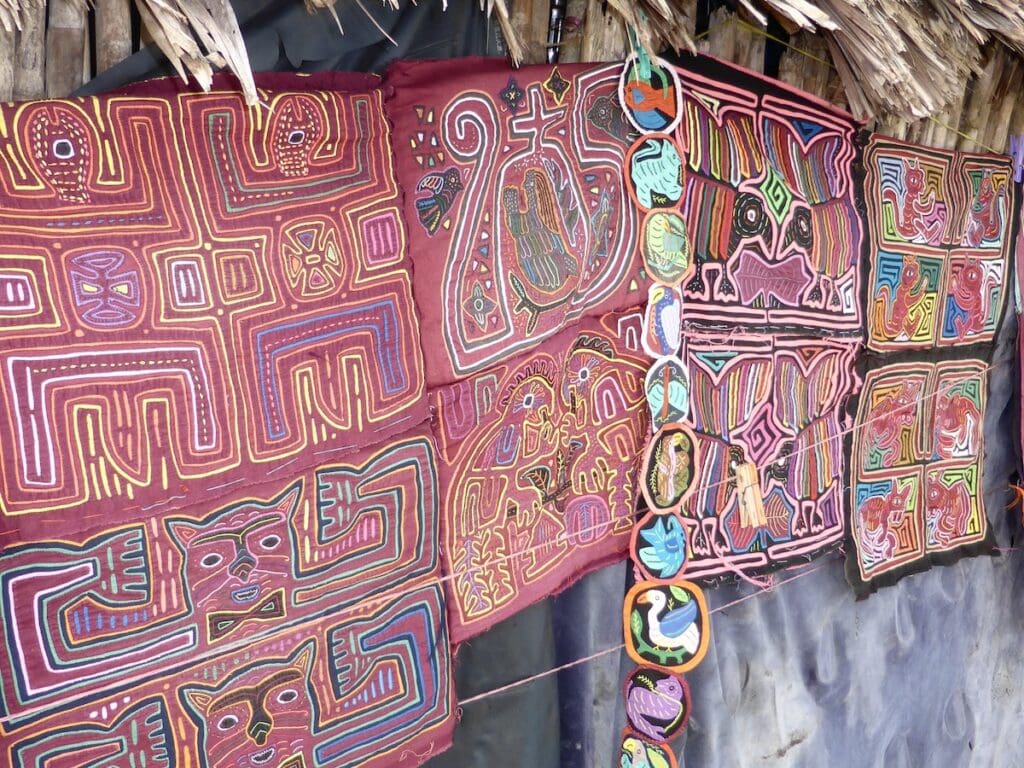
For me, a large part of the appeal of Guna Yala is that it offers the rare combination of a tropical escape and the opportunity to learn. The islands are undeniably beautiful, but it is the chance to learn about the Guna people, their culture, traditions, and crafts that transforms this from a simple island-hopping vacation into something far more meaningful. More than a decade after my first visit, it was still a place I couldn’t stop thinking about.
How to Experience Guna Yala
Most visitors experience Guna Yala in one of two ways.
The first is to stay in one of the simple, locally owned lodges located on individual islands throughout the archipelago. These accommodations range from rustic cabins to slightly more comfortable eco-lodges, but visitors should generally expect basic facilities and limited amenities. Put more plainly, if a luxury lodge experience is what you are seeking, you won’t find it here. In many cases, the experience is closer to camping—or, at best, glamping—than a traditional beach resort vacation.
The second option—and my personal recommendation—is to explore the San Blas Islands of Panama on a multi-day sailing trip.
Most boats, whether catamaran or monohull, are privately chartered and come with a captain and at least one additional crew member who helps with everything from preparing meals to coordinating island visits and excursions. While the starting price is generally higher than staying in a basic island cabin, the range of accommodations is also much broader. Some boats are fairly simple, while others are surprisingly luxurious (where you might find linen thread counts listed in the cabin details).
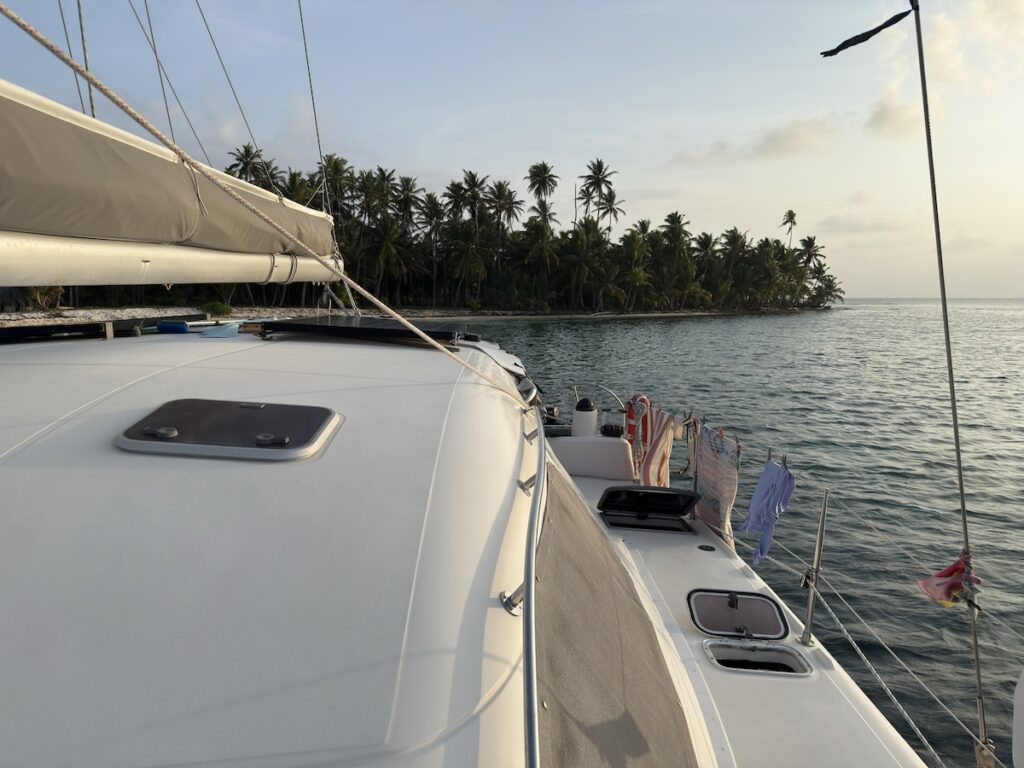
Because the San Blas Islands are spread across hundreds of islands, sailing allows you to experience a much wider variety of beaches, snorkeling spots, and Guna communities than you could from a single island base. It also means waking up each morning in a new and beautiful location.
While both options offer the opportunity to experience Guna culture and the natural beauty of the region, sailing provides a level of freedom and access that is difficult to match from a land-based stay.
True story: I recently chatted with an adventurous and intrepid traveler who spent a week on a single island and sheepishly described it as “a little boring.” In retrospect, she realized that island hopping would have provided a much more interesting experience.
Of course, before you can start island hopping through Guna Yala, you first have to get there. As with many of my favourite destinations, reaching this remote region of Panama takes a little effort—but trust me, it is worth it.
How to Get to the San Blas Islands from Panama City
Option 1: By 4×4 Truck
For most visitors, a San Blas Islands sailing trip begins with a very early morning pickup from their Panama City accommodations—typically around 5 a.m. The early departure helps avoid the worst of Panama City traffic and ensures vehicles reach Guna Yala in time to connect with the boats heading out to the islands.
Most transfers are shared and typically carry six passengers in addition to the driver, although private transfers can also be arranged for roughly double the per-person cost. On both of our trips to Guna Yala—more than a decade apart—we used Lam Tours. Given that they were still operating smoothly all those years later, I’d say they have stood the test of time.
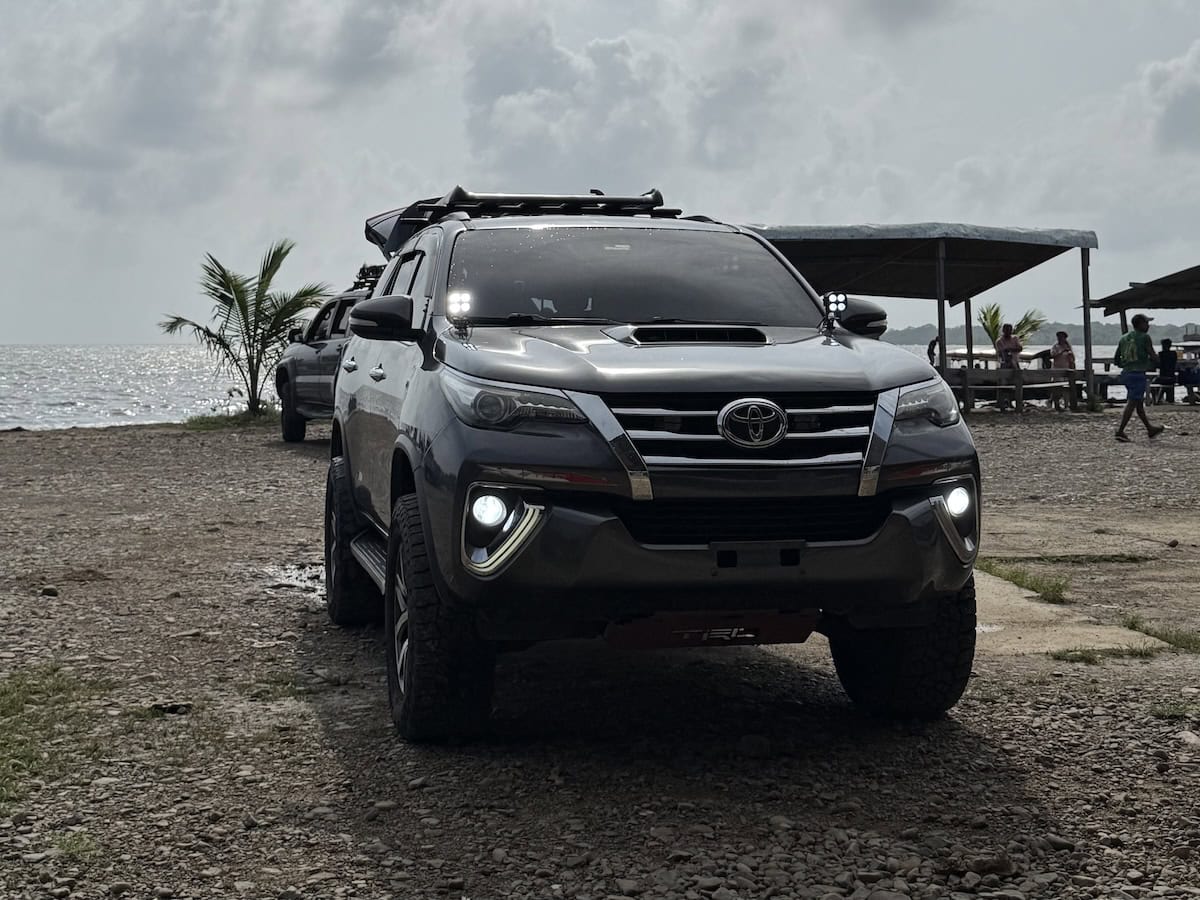
At the time of our trip, the roundtrip transfer cost was $155 USD per person, paid directly to the driver in cash. In addition, visitors must pay a separate entrance fee of $23 USD per person when passing through the checkpoint into Guna territory. You will also need to show your passport.
Along the way, there is a brief stop where you can buy breakfast, use the washroom, and pick up any last-minute snacks or supplies. If you need specialized items, however, I would recommend purchasing them in Panama City before departure.
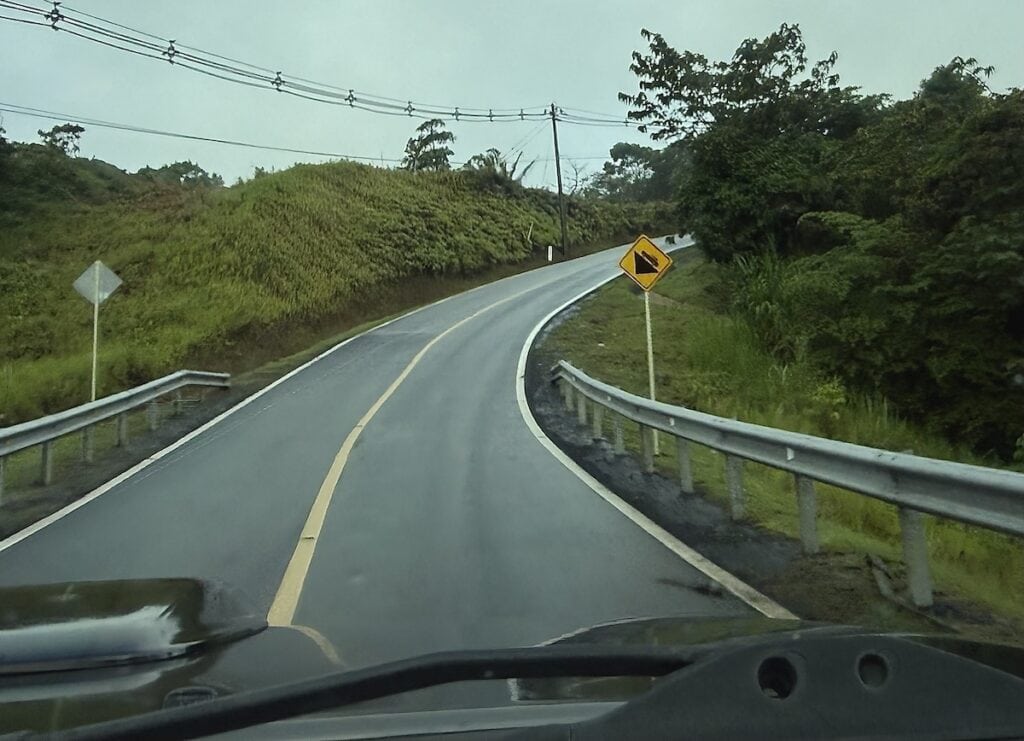
One thing worth knowing: the final hour of the drive involves crossing over the hills between Panama’s Pacific and Caribbean coasts on a very winding road. In fact, our driver referred to this section as the licuadora—Spanish for blender. As someone who had the front passenger seat on the way there, and the much less coveted back seat on the return trip, I can tell you that my stomach was much happier up front.
Once you arrive at the port, things can feel a little chaotic. There are boats coming and going, passengers arriving from all directions, and the facilities are very basic. This is where having a reputable transfer company is helpful. Lam Tours kept track of everyone from our 4×4 and made sure we boarded the correct boat to meet our respective sailboats.
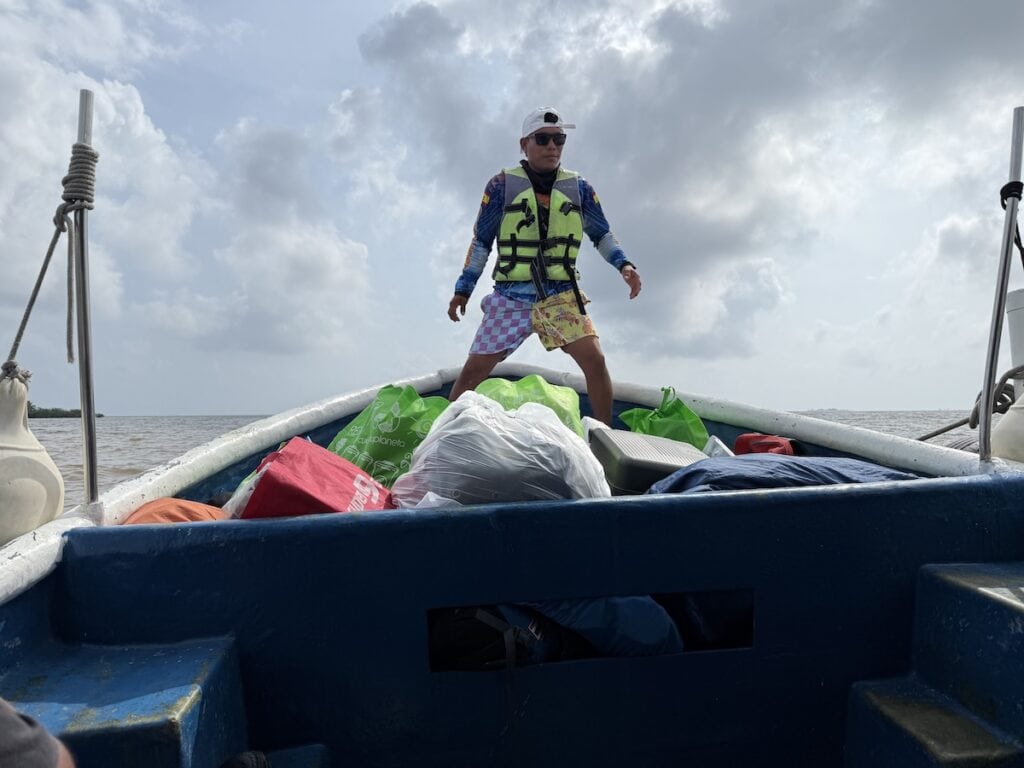
The boat ride to our catamaran took about an hour, although travel times will vary depending on where your sailboat is anchored. To give you an idea of the overall travel time, we were picked up in Panama City at approximately 5 a.m. and stepped aboard our catamaran around 11 a.m., making the total journey from Panama City to boat roughly six hours.
Option 2: Fly to the San Blas Islands
While there is no scheduled commercial air service to Guna Yala, it is possible to charter a private plane from Albrook Airport (PAC), Panama City’s domestic airport. If you are arriving internationally at Tocumen International Airport (PTY), allow approximately 30–60 minutes to transfer between the two Panama City airports, depending on traffic.
Charter flights typically cost between $600 USD and $2,000 USD each way, depending on the aircraft and group size. Options range from small Cessnas carrying as few as three passengers to larger Kodiaks accommodating up to nine.
The flight to the airstrip on Corazón de Jesús Island in eastern Guna Yala takes approximately one hour. In addition to the charter cost, visitors must pay a $24 USD (cash) per person entrance fee upon arrival. Your sailing operator should be able to recommend a charter company, arrange the flight, and coordinate the short boat transfer from the airstrip to your catamaran. This is probably the easiest option, since they will know which airline and flight arrangements work best for your particular sailing itinerary.
Note: Private charters can also potentially be arranged from other destinations within Panama, including Bocas del Toro.
If you prefer to research charter flights yourself, companies to look into include Fly San Blas, Aero Albrook and Blue Skies Panama. Keep in mind that some companies offering these flights are charter brokers rather than the actual aircraft operator, so it is worth asking which licensed Panamanian air carrier will operate your flight before booking. I haven’t personally flown with any of the companies listed above, so I’m including them as a starting point for your own research rather than as personal recommendations. (As someone who isn’t particularly fond of small-plane travel, I tend to do a pretty deep dive into both the operator and its safety record before booking, and I’d encourage you to do the same.)
Option 3 : Fly In, 4×4 Out
An interesting option recommended by Ulu Sailing is to fly into Guna Yala and take the 4×4 transfer back to Panama City. This gives you some of the benefits of flying without paying for a private charter in both directions. You don’t have to get up nearly as early on your first morning, yet you can still arrive at your boat at roughly the same time as guests coming by road.
On the way back, you can take the much more affordable boat-and-4×4 transfer to Panama City. Since the return journey already starts from the islands, you also don’t have the same painfully early wake-up that comes with traveling from Panama City to San Blas by road.
For most travelers, the 4×4-and-boat combination (no flying) remains the most practical and affordable way to reach the San Blas Islands (90% of people do it this way). However, if you are short on time, prone to motion sickness, traveling as a small group, or simply want to avoid the famous licuadora road, a private charter flight can be a very appealing alternative.
Map of San Blas Islands
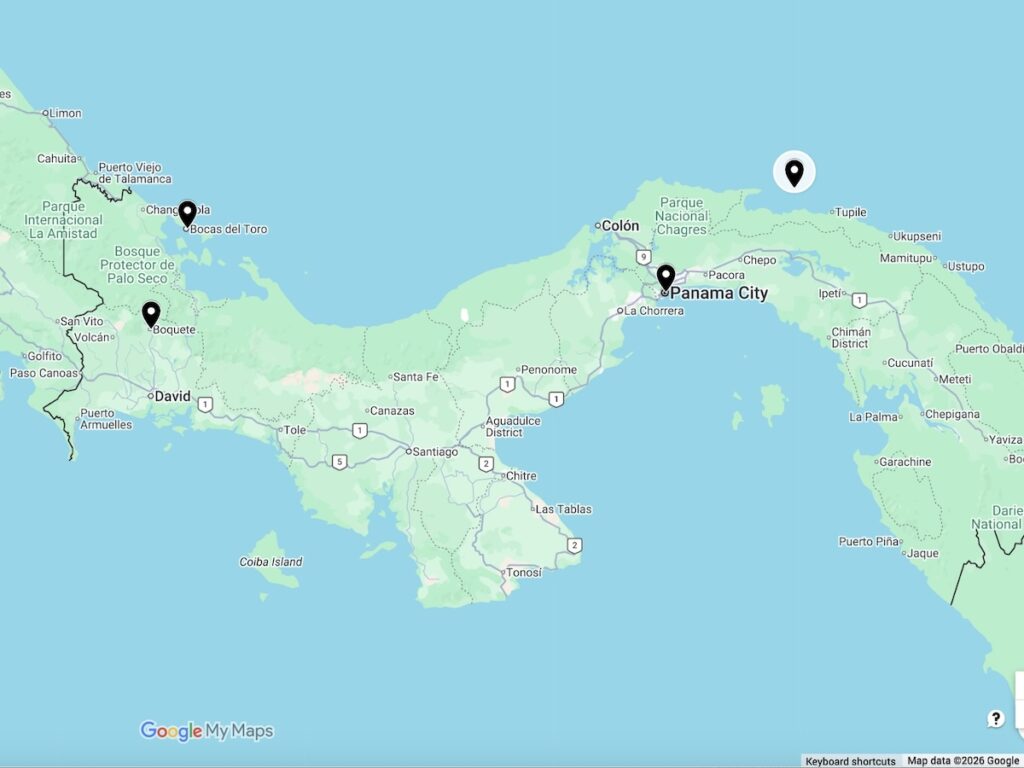
For the sake of convenience, I have provided this Google Map of Panama, to show you exactly where Guna Yala is in relation to other places you may wish to visit in Panama. Please click on this link or the map image for an interactive version.
Why I Chose Ulu Sailing
Before I share what this adventure was actually like, I want to take a moment to explain why I chose to book our 4-day/3-night Guna Yala sailing trip with Ulu Sailing.
One of the biggest challenges of planning a trip to the San Blas Islands is simply figuring out who to book with. There are numerous companies offering multi-day sailing trips throughout the region, many of them operating just one or two boats. While this creates plenty of options, it can also make it difficult to compare experiences, understand what is included, and know exactly what kind of trip you are signing up for. As you’ll soon discover, the logistics of visiting Guna Yala can be a little complicated.
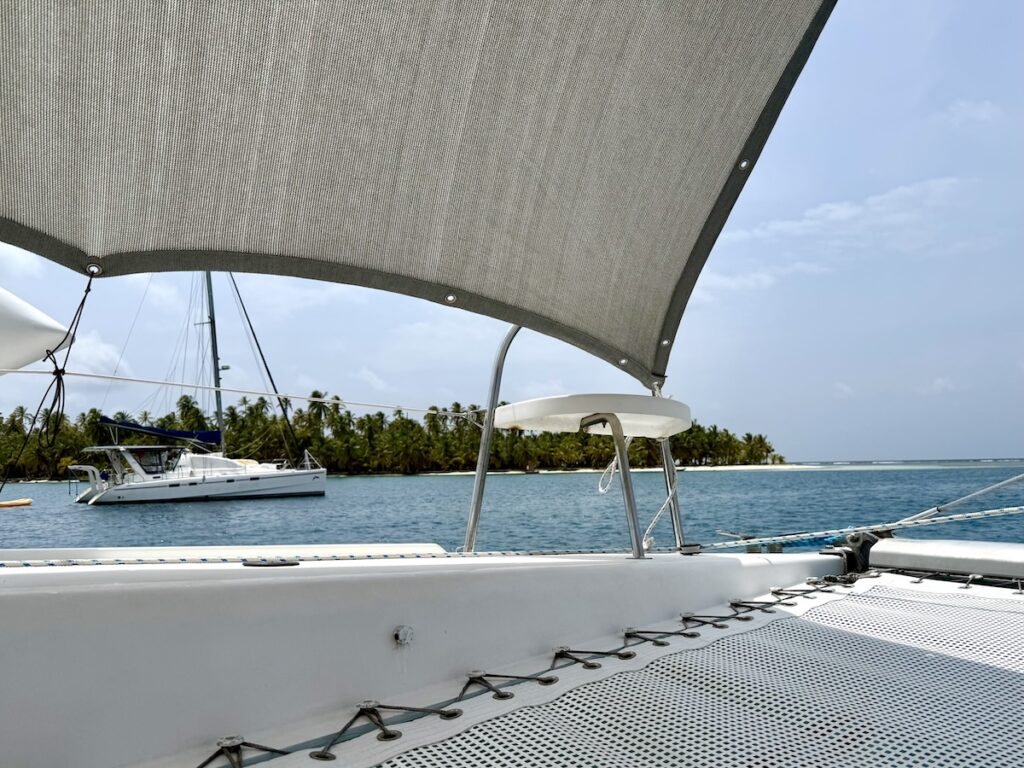
About 18 months before this trip, I attended a conference in Panama City focused on responsible and sustainable adventure travel. During a walking tour, I happened to meet Estefanía (Stef) Gamarra, the founder of Ulu Sailing. As we walked and talked, I learned that Stef had spent many years living and working in Guna Yala. Her deep knowledge of the region and longstanding relationships within the community immediately had me intrigued.
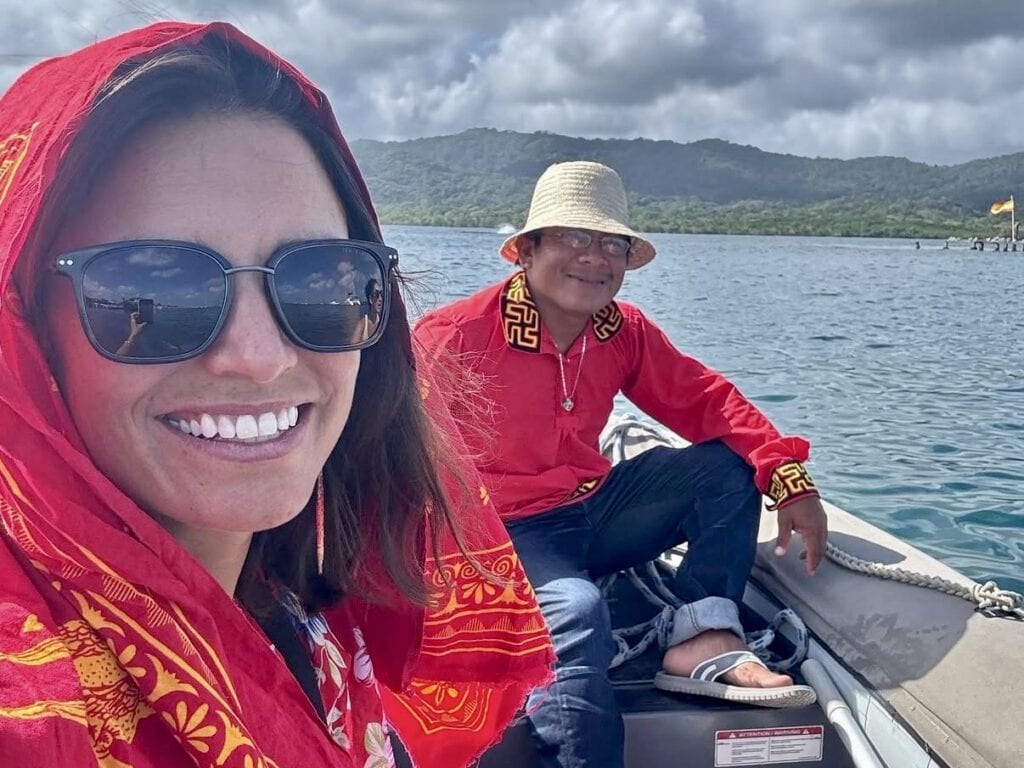
I had always hoped to return to Guna Yala someday and, after meeting Stef, I knew exactly who I wanted to book with when that day came. It certainly didn’t hurt that Ulu Sailing also has an excellent reputation and consistently receives excellent reviews from past guests.
Most importantly, experiencing Guna Yala in a way that was respectful of both the local culture and the people who call these islands home was important to me. After speaking with Stef, I felt confident that she could help make that happen.
I’m happy to report that I was right. The trip exceeded every expectation.
Our San Blas Islands Sailing Experience
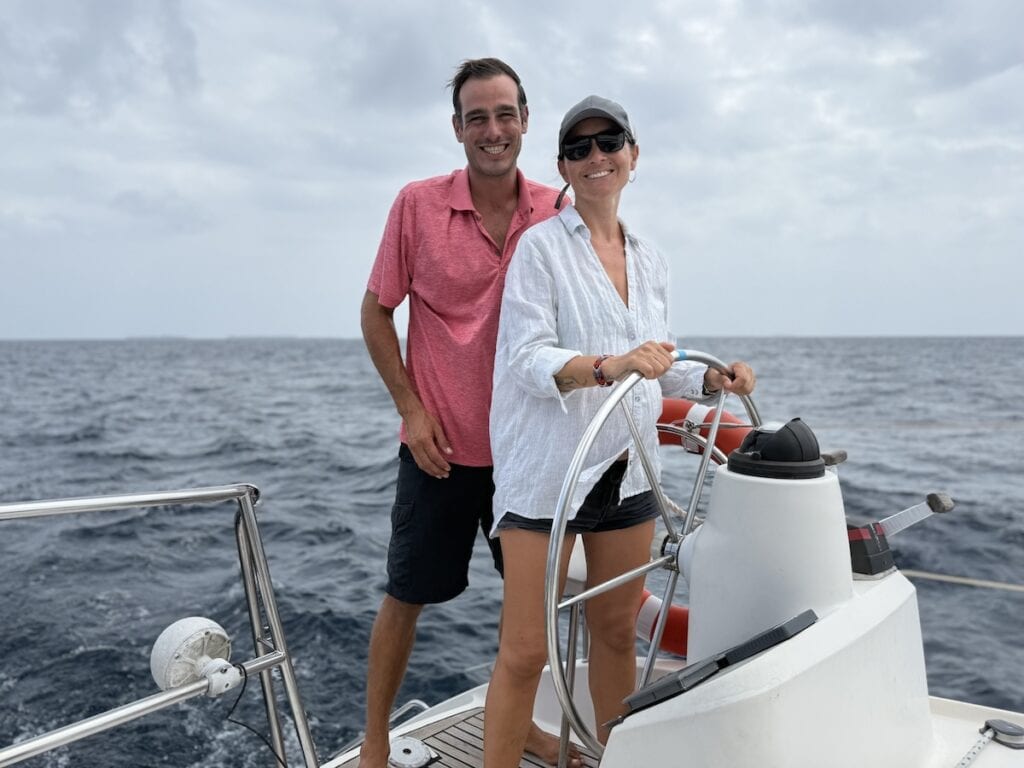
Although our start from Panama City was an early one and the drive a little bumpy, any travel stress quickly melted away once we stepped aboard the catamaran Kaya, our home for the next four days and three nights. Captain Ahielen and her partner and first mate, Gastón, immediately made us feel at home. Well, much better than home, actually, because we were pretty much doted on for the entire trip.
Day 1
After settling into our cabins, we quickly got our bearings. With only the two of us as guests onboard, we each had our own small cabin on the port side of the boat, with a compact bathroom in between.
After lunch, we set sail and immediately claimed what would become our favourite spot on the boat: the hammock at the bow. Before long, we arrived at a sheltered anchorage off the island of Sibadup, surrounded by turquoise water, white sand, and gently swaying coconut palms.
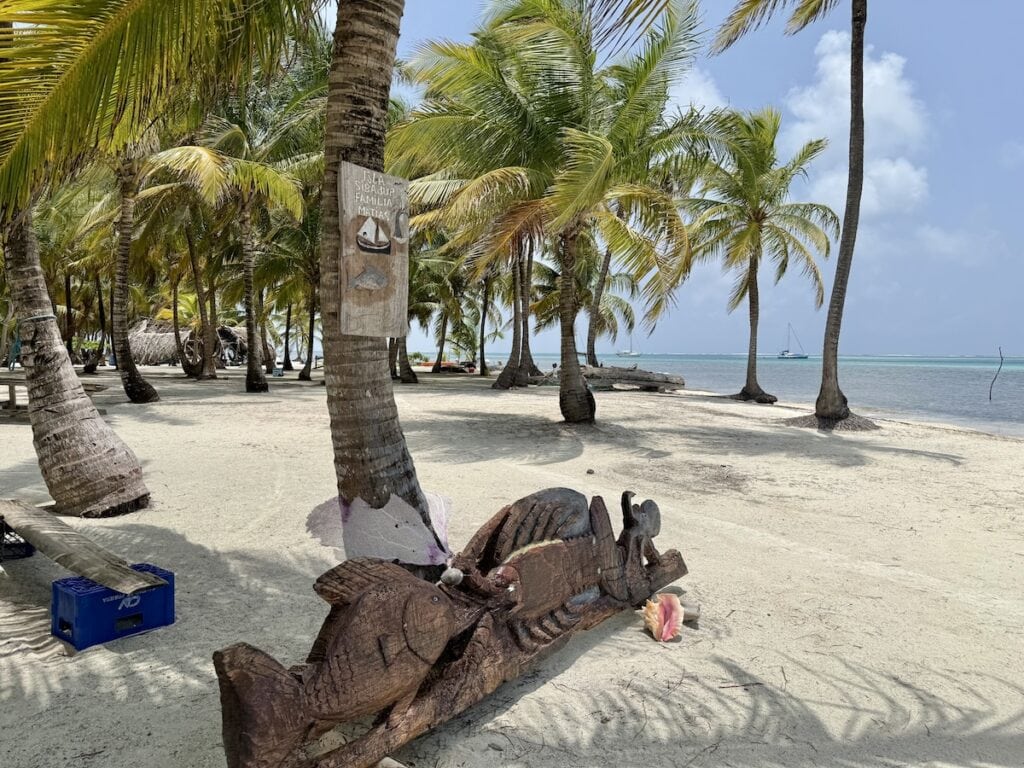
Most of the islands in Guna Yala have a Guna custodian, often a family responsible for caring for the island for a period of time before another community member takes over. Visitors are generally expected to pay a small fee to use the island (in this case, $2 per person), which helps cover its upkeep.
This particular island was impeccably maintained, with neatly raked sand, benches for relaxing, and even the opportunity to purchase a freshly cut coconut for a few dollars more. We swam—we wandered the beach—we did very little at all. It was perfect! Then we returned to the boat for sunset cocktails and another wonderful meal.
Needless to say, after a 4:15 a.m. wake-up in Panama City, it didn’t take long for the gentle rocking of the boat to lull us to sleep.
Day 2
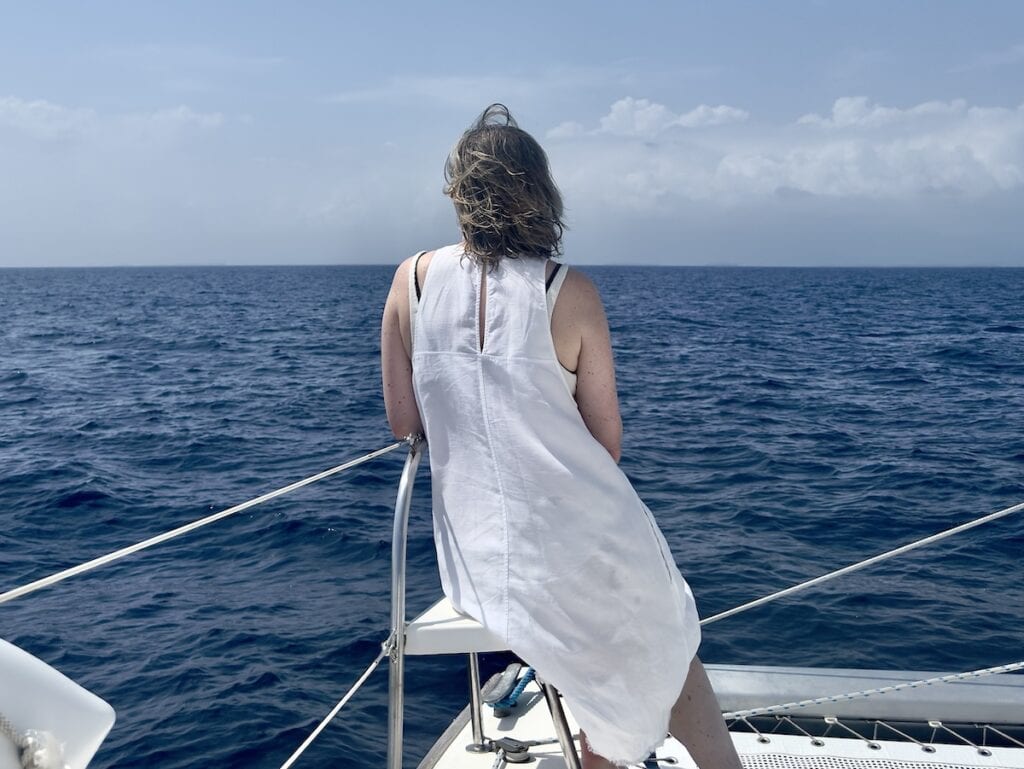
I awoke to one of my favourite smells: freshly brewed coffee. Mug in hand, I scrambled (I have absolutely no sea legs) to my usual spot at the bow. As the sun rose over the water, I was reminded exactly why I had wanted to come back to Guna Yala.
After breakfast, we did a little snorkeling. Despite the clear water and healthy reefs, Guna Yala is not as well known for snorkeling and diving as other destinations in Panama, such as Coiba National Park, the Gulf of Chiriquí, or Bocas del Toro. That said, there is still some interesting marine life to be found.
For example, just when I had convinced myself we weren’t going to see much of anything, we spotted two sharks gliding near our catamaran, each about 2.5 metres long. I wish I had lingered longer, but to be honest, I only identified them as harmless nurse sharks later. Instead, I swam back toward the boat at a brisk pace while attempting to look calm and collected, lest I be mistaken for a panicked, injured mammal.
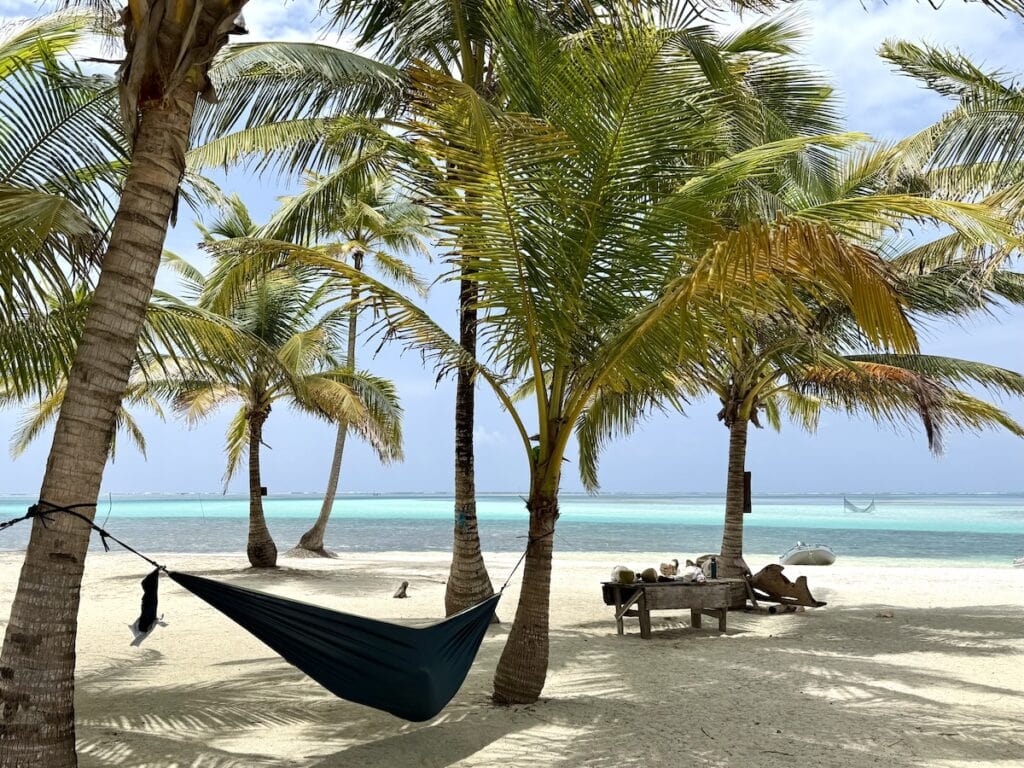
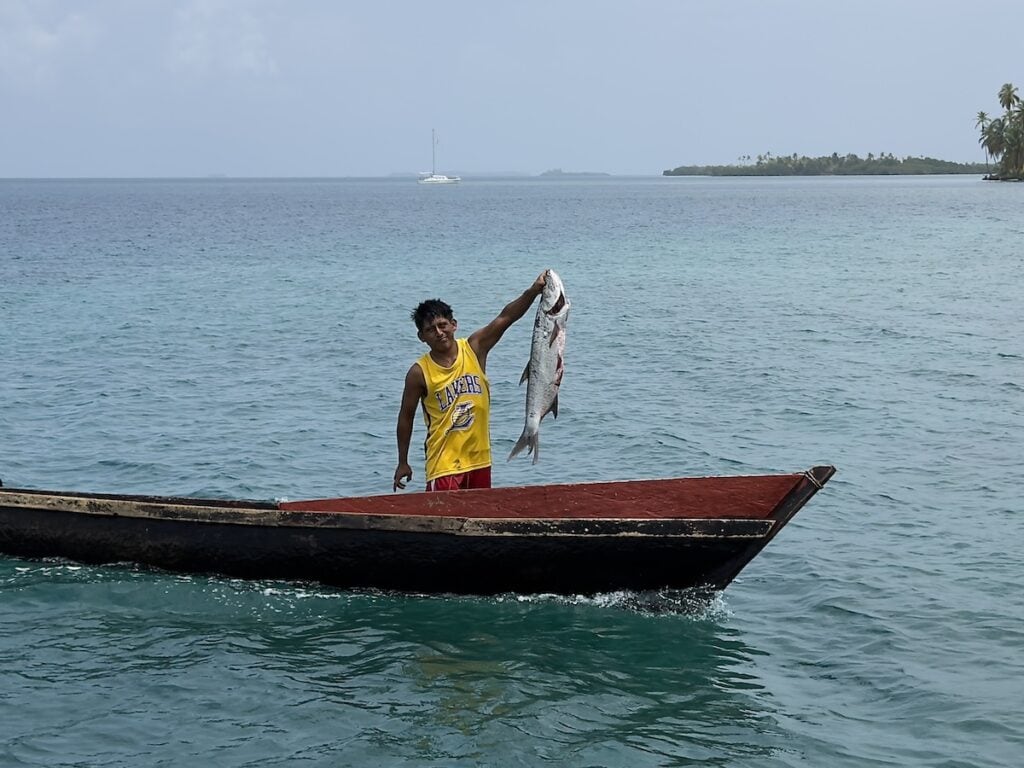
After this leisurely morning, we hopped back into the dinghy and returned to Isla Sibadup for a beach barbecue. Ahielen set up hammocks for us beneath the swaying palms while Gastón got to work on lunch. Before long, the barbecue was loaded with delicious food, including fresh fish purchased from a Guna fisherman who had pulled up alongside our catamaran the day before.
Guna Yala’s Floating Marketplace
This is one of my absolute favourite things about sailing in Guna Yala.
You can be anchored in what feels like a completely secluded corner of the archipelago when suddenly you notice a tiny speck on the horizon. As it gets closer, you realize it’s a small boat or motorized dugout canoe making its way toward you. And then, quite literally, the market comes to you.
Sometimes it is fishermen selling their catch. Sometimes it is a family offering fresh fruits and vegetables. Other times it is an artisan carrying colourful molas. While you might think that spending your days anchored off tiny islands would leave you feeling somewhat removed from local life, quite the opposite is true.
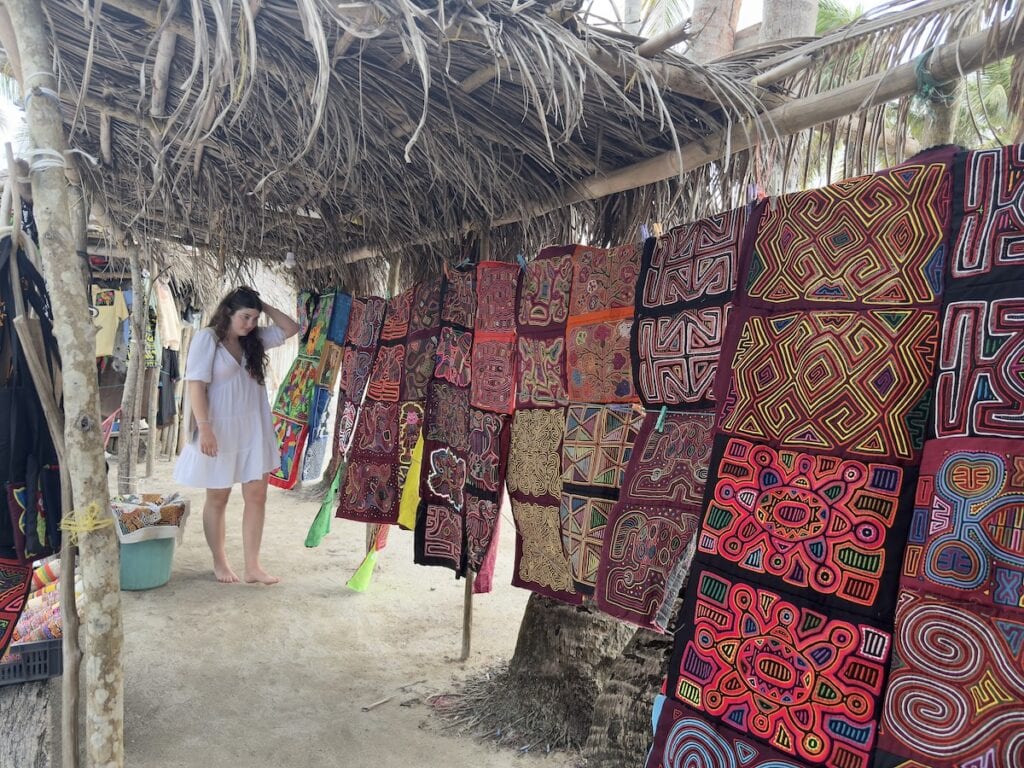
Later that afternoon, we sailed to another island, home to a well-known mola artist named Prada (or Prado—it was our choice). Not only did Prada have a beautiful collection of molas, but the island itself offered a fascinating glimpse into daily life in Guna Yala. (One of the things I found particularly interesting while learning about Guna culture was the traditional recognition of omeggid, a gender identity recognized as distinct from both men and women in Guna society.)
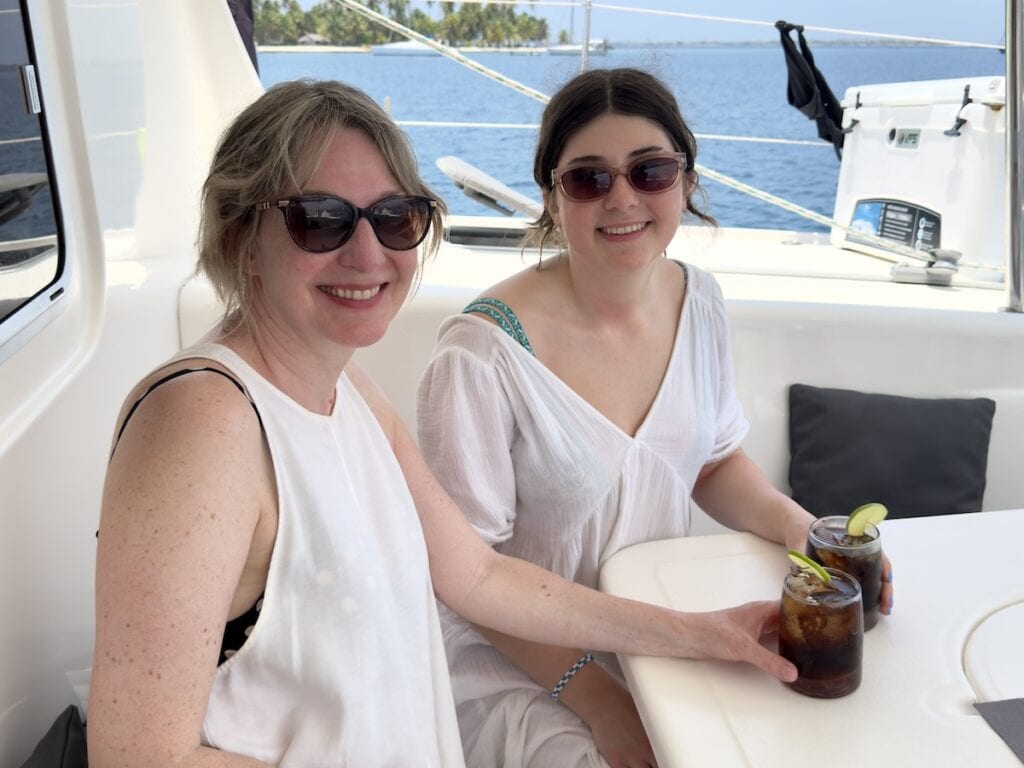
Another idyllic afternoon slipped by and before we knew it, we were back on the boat sipping Cuba Libres and watching the sun sink below the horizon. After another excellent dinner courtesy of Gastón, we were once again in bed by 9 p.m. (I realize that my schedule isn’t for everyone, but I am hopelessly addicted to mornings and hate missing a sunrise.)
Day 3
Day 3 began much like Day 2 for me: coffee in hand, watching the sunrise from the bow of the Kaya and feeling full of gratitude. After another wonderful breakfast prepared by Gastón, the three of us headed out for a snorkel.
I know I mentioned earlier that Guna Yala is not particularly famous for its snorkeling and diving, but the marine life off Prada’s Island was actually quite good, with colourful fish, healthy coral, and even a few rays.
After a visit from some locals selling fresh produce, we set sail for our final island stop. Ella and I spent the afternoon paddleboarding, swimming in the bath-warm water, wandering the island, and listening to music drifting over from a nearby beach bar.
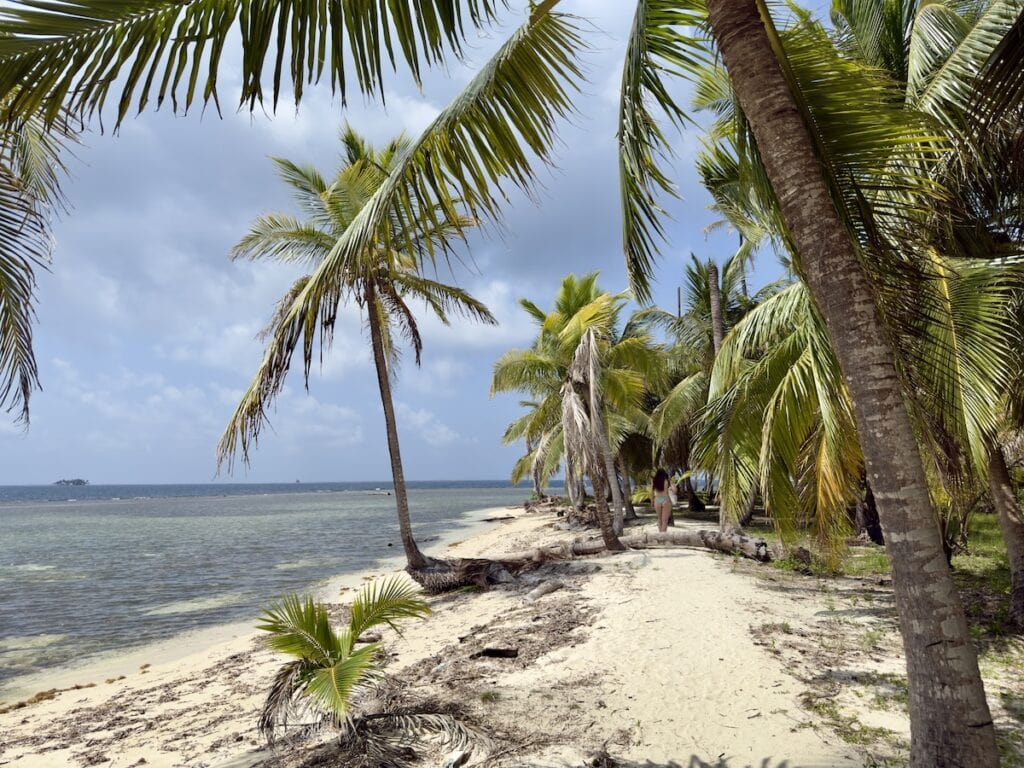
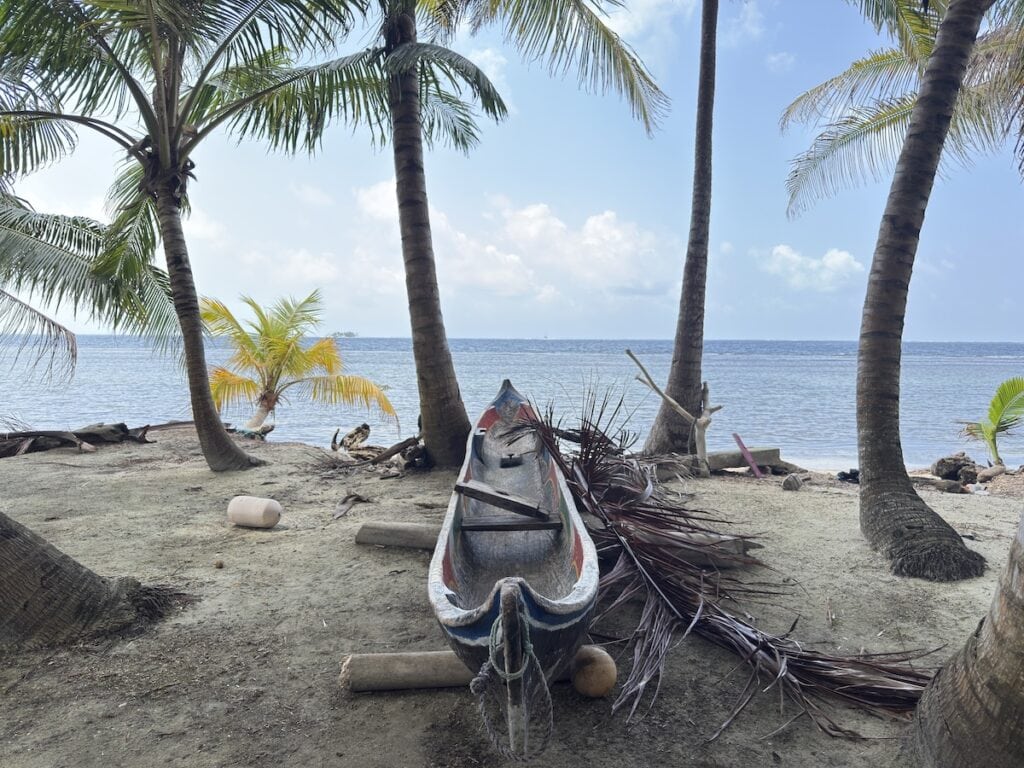
Compared to many of the islands we had visited, this one felt a little livelier, with boats arriving throughout the afternoon and groups gathering for beach volleyball.
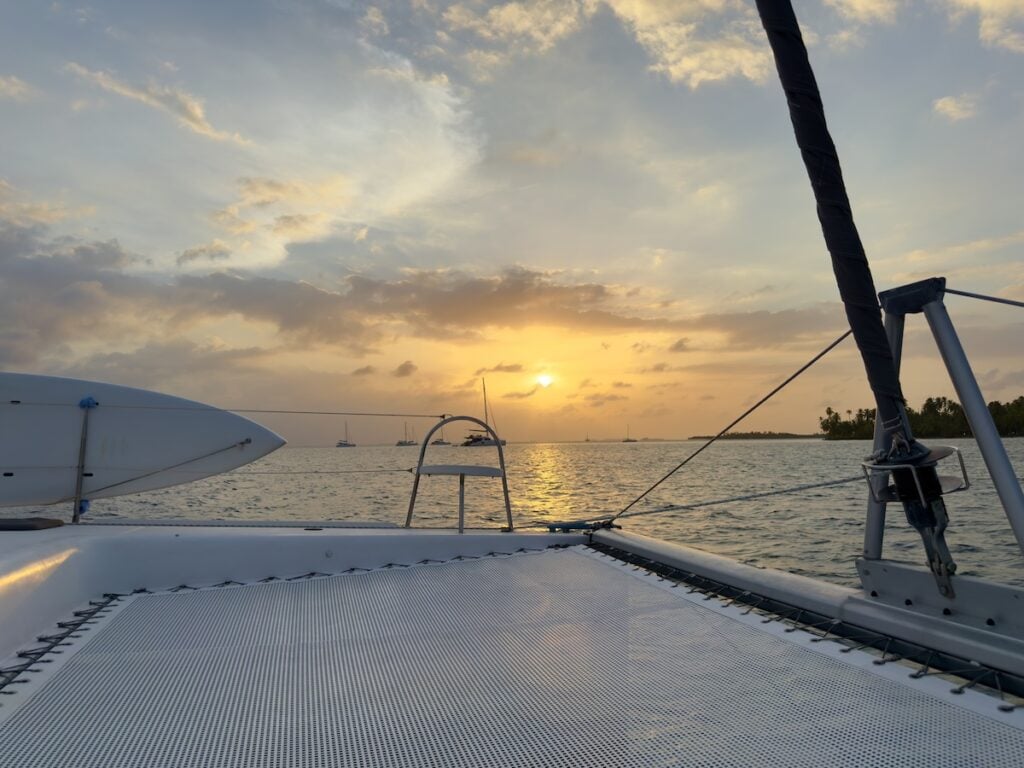
Before long, it was time to head back to the boat. After one final sunset, one last delicious dinner prepared by Gastón, and a final night of being gently rocked to sleep, our Guna Yala adventure was almost at an end.
Day 4
I was up early once again for one final Guna Yala sunrise coffee. As beautiful as the morning was, there was also a touch of melancholy knowing our adventure was coming to an end.
After an early breakfast, we said our goodbyes to Ahielen, Gastón, and the Kaya, then boarded our motorboat transfer at about 7:30 a.m. for the journey back to the mainland. Just as they had promised, Lam Tours was waiting to greet us at the dock and coordinate the drive back to Panama City.
We arrived back at our hotel by about 12:30 p.m. For whatever reason, everything seemed to move a little faster on the way home.
Helpful Tips for Your Guna Yala Sailing Trip
Earlier, I mentioned that one of the biggest challenges of planning a sailing trip in Guna Yala is simply figuring out who to book with. While the experience itself is wonderfully simple, the logistics of arranging boats, transfers, island fees, and accommodations can be surprisingly complicated. Here are a few tips that I hope will make planning your own Guna Yala adventure a little easier.
Use a Reputable Sailing Company or Booking Agent
A Guna Yala sailing trip is not especially easy to arrange on your own. For this adventure, I highly recommend working with a company that can answer questions, coordinate transfers, and help ensure that all of the moving pieces come together smoothly. Given the time, cost, and effort involved in getting to Guna Yala, I think it is worth spending a little extra time finding an operator with strong reviews and a solid reputation.
For me, that company was Ulu Sailing, but regardless of who you choose, I would strongly recommend doing your research and booking with someone you trust.
Spend a Night in Panama City Before Your Trip
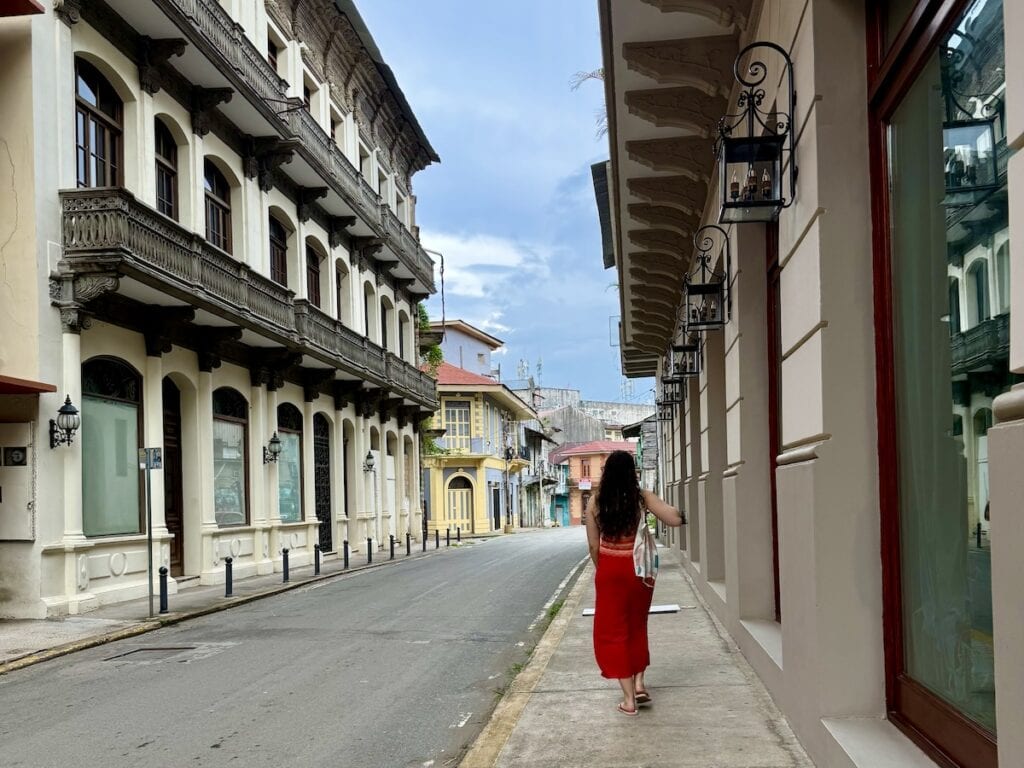
If you are travelling to Guna Yala via a 4×4 transfer, the 5:00 a.m. departure makes an overnight stay in Panama City essential. My personal favourite area to stay is the UNESCO-listed neighbourhood of Casco Viejo. I love its colourful streets, historic architecture, lively plazas, and excellent restaurants. (See my Casco Viejo guide here.)
Leave Your Large Luggage Behind
Whether you stay an extra night in Panama City after your trip is a personal choice. Most sailing trips return to the city in the early afternoon, so it is entirely possible to continue on with your travels that same day.
That said, on both of our visits to Guna Yala, we chose to stay at the same hotel before and after our sailing trip. One of the biggest advantages was being able to leave behind any luggage we didn’t need while we were on the boat—which, as it turns out, wasn’t very much. (See the packing list in the next section.)
I would also recommend packing in a small duffel bag or other soft-sided luggage rather than a hard-shell suitcase. Since bags are typically loaded into the bow of transfer boats, it’s a good idea to have a waterproof cover or even a simple garbage bag on hand to protect your belongings from sea spray during the journey.
Note: A huge shoutout to our beautiful hotel in Casco Viejo, La Concordia. Not only did they store our luggage while we were away, but they also had our room ready when we returned to Panama City earlier than expected. Highly recommended!
Keep Your Boat Information Handy
Before leaving Panama City, make sure you have the name of your boat, your captain’s name, and a contact number easily accessible.
When you arrive at the port, things can feel a little chaotic, with multiple boats coming and going and passengers heading off in different directions. Having this information readily available will make it much easier to find your transfer boat and connect with your catamaran.
Don’t Forget Motion Sickness Medication
If you are prone to motion sickness, I would strongly recommend bringing medication for the drive to and from Guna Yala. The final hour of the journey crosses the hills between Panama’s Pacific and Caribbean coasts on a very winding road that locals sometimes refer to as the licuadora (“blender”). You’ll also be boarding a boat shortly after arriving at the port, so it’s better to be proactive than spend the first day of your sailing trip feeling unwell.
Visit the Mola Museum Before You Go
If you have time, I highly recommend visiting the Mola Museum in Casco Viejo before heading to Guna Yala. Not only will you learn about the incredible textile artistry of the Guna people, but you will also gain a deeper appreciation for the history, culture, and traditions of this fascinating Indigenous community. I found it added a great deal of context to the experience.
Bring Cash (USD)
There are no ATMs in Guna Yala, and credit cards are not widely accepted (except, perhaps, when booking your boat), so be sure to withdraw cash before leaving Panama City.
While Panama’s official currency is the balboa, it is tied to the U.S. dollar, and U.S. currency is used for virtually all day-to-day transactions. For that reason, it is best to bring cash in USD.
You’ll need cash for:
- The Guna territory entrance fee
- Payments to your 4×4 driver (if applicable)
- Small island access fees
- Souvenirs and handicrafts
- Crew tips
As a rough guide, island entrance fees are often around $2 USD, handmade bracelets typically sell for about $5 USD, and molas generally range from $20–60 USD or more depending on their size and complexity.
I would also recommend bringing plenty of small bills, as many purchases and fees are only a few dollars.
Don’t Forget Your Passport
Be sure to bring your passport with you. Visitors entering Guna Yala must pass through a checkpoint where passports are checked and entrance fees are collected.
Language Considerations
Knowing some Spanish is helpful, although it is by no means essential. Our crew spoke both English and Spanish, and most of the Guna people we encountered spoke at least a little Spanish and English in addition to Dulegaya, the traditional language of the Guna people. That said, if you do not speak any Spanish at all, I would recommend confirming that your captain or crew speaks English fluently.
San Blas Islands Catamaran Packing List
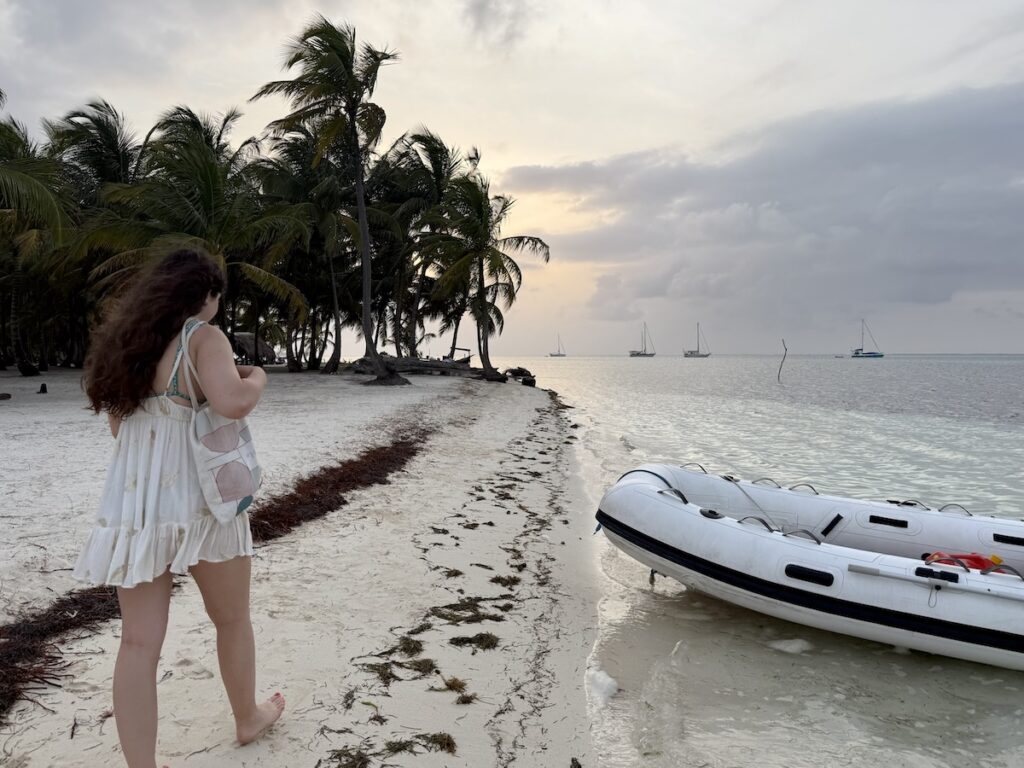
Before I share a full packing list, I want to emphasize that I basically spent three days, barefoot, rotating between two bathing suits, a cover-up, and a hat. Life on a catamaran in Guna Yala is wonderfully casual.
Luggage
- Small duffle bag or soft-sided luggage (much more suitable for boats than a hard suitcase)
- Waterproof bag or garbage bag to keep belongings dry
- Small wet bag or large Ziplock bag for damp items on the journey home
Clothing
- 2 bathing suits (so one can dry while you wear the other)
- 2 cover-ups, sundresses, or a combination of shorts and t-shirts
- 1-2 casual outfits for evenings
- Long-sleeve shirt or light jacket and pants for cooler evenings (we never used though)
- Sandals or flip-flops (only needed on way to/from Guna Yala)
Sun & Water Gear
- Hat that won’t blow away in the wind
- Sunglasses (ideally polarized)
- Rash guard for snorkeling, swimming, or paddleboarding
- Reef-safe sunscreen
- Quick-dry beach towel or sarong
- Refillable water bottle
Health & Comfort
- Insect repellent (helpful for sand fleas during island visits)
- Motion sickness medication (especially for the winding drive to and from Guna Yala)
- Basic medications and small first-aid kit
Electronics
- Phone and/or camera (arrive with everything fully charged)
- Backup battery pack (easier since most boats rely on solar power)
Note: Most catamarans have Starlink onboard. I was also surprised to have 2–5 bars of cell service for much of our trip.
Traveling with Kids
I wanted to include a quick note for families because our first trip to Guna Yala was with young children.
While we packed fairly lightly, there were two things we were glad we brought:
- Kids’ snorkeling gear (to ensure a good fit)
- Kids’ life jackets
Most boats can provide life jackets, but we preferred having gear that we knew fit properly.
San Blas Islands / Guna Yala FAQs
Is a Sailing Trip or Island Lodge Better?
If possible, I highly recommend a multi-day sailing trip in the San Blas Islands rather than staying on a single island. The reason is simple: this archipelago consists of more than 360 islands, and one of the joys of visiting is being able to explore several of them. Most of the islands are also quite small, so unless your primary goal is to completely disconnect and relax, you may find yourself running out of things to do after a day or two.
Should I Take a 4×4 or Fly to the San Blas Islands?
For most travelers, I would recommend the 4×4 transfer from Panama City. It is significantly less expensive than chartering a plane and, while the final hour of the drive is quite winding, it is all part of the adventure.
That said, if you are short on time, prone to motion sickness, or simply looking for a more comfortable arrival, charter flights to Guna Yala are available. The flight takes about an hour and offers a spectacular aerial view of the islands, but comes at a much higher price point.
How Many Days Should I Spend in the San Blas Islands?
I think 3–4 nights is ideal for most visitors. You could certainly do a shorter trip, but given the effort and expense involved in getting to and from Guna Yala, a 2-night itinerary can feel a little rushed.
If you are particularly interested in learning about Guna culture and daily life, however, a longer trip may be worthwhile. For example, Ulu Sailing offers a popular 7-day itinerary that includes more opportunities for cultural immersion and interaction with local communities.
What Does a San Blas Islands Sailing Trip Cost?
Prices vary considerably depending on the type of boat and whether you choose a shared or private charter. As a general rule, expect to pay $250–650 USD per person per day for a shared all-inclusive sailing trip in the San Blas Islands.
Private charters typically start around $1,000 USD per day for the entire boat and can exceed $3,000 USD per day for larger or more luxurious catamarans. Most trips include accommodation, meals, and the services of a captain and crew.
Our situation was a little unique, as I booked this trip through an annual auction benefiting the Adventure Travel Conservation Fund. Had we paid the standard rate, our private 4-day/3-night sailing adventure aboard Kaya would have cost approximately:
- Private catamaran experience for 2 adults: $3,000 USD
- Round-trip transportation from Panama City: $246 USD
- Snacks and drinks during transfers: $40 USD
- Island entrance fees and fresh coconuts: $20 USD
- Souvenirs (molas): $180 USD
- Tips: $400 USD
Total: $3,886 USD, or $1,943 per person for our 4-day/3-night trip.
A few notes about this example. First, this was a completely private trip with just my daughter and me aboard. Second, while Kaya was clean, comfortable, and very well maintained, she was not one of the newest luxury catamarans in the fleet. Had we shared the boat with other guests, the cost per person would have been considerably lower. Conversely, a newer catamaran with larger cabins, more amenities, and additional crew could cost significantly more.
How Much Should You Tip on a San Blas Islands Sailing Trip?
Tipping can be a little confusing, as there is no universal standard. From my research, however, a gratuity of 5–15% of the trip cost shared among the captain and crew seems to be the most commonly recommended range.
If you are from Canada or the United States, this may feel a little low compared to what you are used to. Of course, if you receive exceptional service, you are always welcome to tip more. Likewise, on higher-end catamarans with larger crews and a more luxury-oriented level of service, a gratuity above 15% may be appropriate.
As with many things in Guna Yala, tipping practices can vary from boat to boat, so if you are unsure, don’t hesitate to ask your operator what is customary.
What Is the Best Time of Year to Visit the San Blas Islands?
Many travelers consider the dry season (roughly December through April) to be the best time to visit the San Blas Islands thanks to its generally sunny weather and reliable trade winds.
That said, our most recent trip took place in early May, and we enjoyed excellent weather throughout, with only one brief rain shower. In fact, the lighter winds and calmer seas made for wonderful swimming, snorkeling, and relaxing aboard the boat. The trade-off, of course, is that lighter winds can mean less actual sailing. During calmer periods, your captain may need to rely on the engine more often to move between islands.
If weather is a major consideration, it is always worth checking with your sailing operator before booking. You may also find lower prices and greater availability during the summer months.
Is There Cell Service or Wi-Fi in the San Blas Islands?
Yes, although it can vary depending on where you are in the archipelago and what type of boat you are sailing on.
During our most recent trip, I generally had between two and four bars of cell service throughout much of Guna Yala, although there were occasional stretches with little or no signal. Our catamaran was also equipped with Starlink, which allowed us to stay connected when needed.
That said, I would not assume that every boat offers Wi-Fi. If staying connected is important to you, I would recommend confirming internet availability with your operator before booking.
Can You Visit the San Blas Islands Independently?
Yes, it is possible to visit the San Blas Islands independently, but I would not personally recommend it for most travelers.
The logistics of getting to and around Guna Yala can be surprisingly complicated, requiring you to arrange transportation, boat transfers, accommodations, and entrance fees yourself. For most visitors, booking through an experienced operator or joining a sailing trip is a much easier and more enjoyable option.
Is Guna Yala Safe?
In my experience, yes. I have visited Guna Yala twice and felt very safe on both visits. The Guna communities are welcoming to visitors, and tourism plays an important role in the local economy.
To put it into perspective, I felt perfectly comfortable leaving my belongings on the beach while I went swimming during island visits—something I would hesitate to do in many places around the world, including my home city of Vancouver.
Of course, common-sense precautions still apply, but safety was never a concern during either of my trips.
After two visits to Guna Yala more than a decade apart, I can honestly say it remains one of the most memorable destinations I have ever experienced. The combination of stunning Caribbean scenery, fascinating culture, and the simple joy of moving from island to island by sailboat is unlike anything else I have found in Panama—and perhaps anywhere else in the world.
If you decide to go, I hope you love it as much as I do.
Learn More
I hope this post on a San Blas Island catamaran trip answered all (if not, most) of your questions. If there is anything else you need help with, please feel free to reach out to me via direct message on Instagram, Facebook or by email.
Want to see more unique adventures? I would love for you to follow along with The Better Beyond on Instagram!
More Travel Guides
- Best Things to do in Casco Viejo, Panama City
- The Best Hotels in Casco Viejo, Panama City
- Isla Palenque – Luxury Eco Lodge, Panama
- Lapa Rios – Luxury Eco Lodge, Costa Rica
- 7 Reasons to Visit Costa Rica in Rainy Season
- Guide to Barranco – Lima’s Coolest Neighbourhood
- The Best Boutique Hotels in Lima, Peru
- How to Swim With Whale Sharks in La Paz, Mexico
- Luxury Lodge-to-Lodge Hike to Machu Picchu
Pin for Later!